Sleep positioning · Practical guide
Adjustable Beds and Sleep Positioning: What to Consider
A bed that moves can make it easier to settle into a comfortable position, read before sleep, or raise your legs for a while. But the right setup depends on more than the base: your mattress, usual sleep posture, room, and the person sharing the bed all matter.
Adjustable beds are often described as a simple comfort upgrade. In practice, they’re a combination of moving parts and sleeping surfaces that need to work together. Raising the head or legs changes the angle of your body and the way your weight meets the mattress. That may feel supportive to one sleeper and awkward to another. A little testing—and a few compatibility checks—can help you decide whether an adjustable base suits your routines.
What an adjustable bed changes
An adjustable bed base allows some sections of the mattress to move, most commonly the head and foot. Some models raise only the head; others elevate both ends independently and may offer preset positions or programmable controls. These features change the shape of the sleeping surface, so your posture changes with it.
With the head raised, your upper body rests at an incline rather than lying flat. With the legs elevated, your knees and lower body may bend or rise relative to your hips. Raising both sections can create a gently curved posture. Small changes in angle can feel surprisingly noticeable because the mattress is supporting your body in a different arrangement.
That doesn’t mean an adjustable position is automatically better for sleep. Comfort is personal, and the most relaxed angle while reading may not feel right once you’re trying to sleep. Think of the controls as a way to explore options—not as a guarantee of a particular health benefit. If you have a medical concern, ask a qualified healthcare professional whether changing your sleeping position is appropriate for you.
Start with the way you sleep
Your usual sleep position gives you a useful starting point, though it shouldn’t dictate a single setting. The aim is to find a posture that feels comfortable, lets you relax, and doesn’t leave you fighting the mattress through the night. Try modest adjustments and notice how your whole body feels, not just the area you hoped to relieve.
Back sleepers
People who sleep on their backs may enjoy a slight lift under the head or a gentle bend beneath the knees. These positions can feel restful for some sleepers, while a steep incline can feel like the body is sliding toward the foot of the bed. If you wake with tension or find yourself bracing against the mattress, lower the angle and reassess. A neutral, easy-to-maintain position is usually more practical than a dramatic pose.
Side sleepers
Side sleeping can be comfortable on an adjustable bed, but alignment deserves attention. The head should feel supported rather than pushed toward the chest or tilted sharply to one side. A high head angle may also make it harder to settle on your shoulder, so try a small lift before exploring more pronounced positions. Check that your pillow still fills the space between your head and mattress comfortably when the base moves.
Stomach sleepers
Stomach sleeping can become less comfortable if an incline bends the body in a way that feels unnatural. Many stomach sleepers prefer a flatter surface, and a raised head can make it harder to find a relaxed position. If this is your usual posture, test the bed in a nearly flat configuration first. Don’t assume that using every adjustment feature is necessary; leaving the base flat is a valid way to use it.
Combination sleepers
If you change position during the night, consider how easily you can turn and move while the bed is inclined. A position that feels lovely when you first settle in may make rolling over less convenient. Try changing sides and shifting your legs at several settings. The base should support your routine, not ask you to stay perfectly still to enjoy it.
Comfort is about the whole body
When testing a position, it’s easy to focus on the head because that is often the most visible adjustment. But your neck, shoulders, back, hips, and legs all respond to the change. A raised head can alter where your weight rests. A raised foot section can change the bend at your knees and hips. The right angle is the one that feels balanced across your body rather than excellent in one spot and uncomfortable everywhere else.
Notice whether you feel as though you’re sliding, whether your lower back feels strained, and whether your pillow remains comfortable. Check for pressure or pinching at the point where the bed bends. If a setting feels fine for a minute but uncomfortable after a longer rest, it may not be a useful overnight position. Take your time: the body often needs more than a quick showroom-style test to show what feels sustainable.
Preferences can also vary by activity. You might choose one position to read, another to relax, and a flatter one for sleep. It’s reasonable to use separate settings for separate parts of the day. If the base has programmable controls, take a moment to understand how to save, adjust, and return to your preferred positions rather than relying on unfamiliar presets.
Mattress flexibility and bed compatibility
The mattress and base have to move as a unit. A mattress that bends readily is generally a more suitable candidate for articulation than one whose construction is rigid, unusually thick, or dependent on a traditional fixed foundation. Still, material alone does not settle the question. Design, internal layers, construction, and the manufacturer’s instructions all matter.
Before placing an existing mattress on an adjustable base, check its care guide or ask the manufacturer whether that specific model is approved for adjustable use. Also review the base maker’s requirements for mattress size, weight, thickness, and attachment. The fact that a mattress appears flexible by hand is not proof that it is designed to flex repeatedly under load.
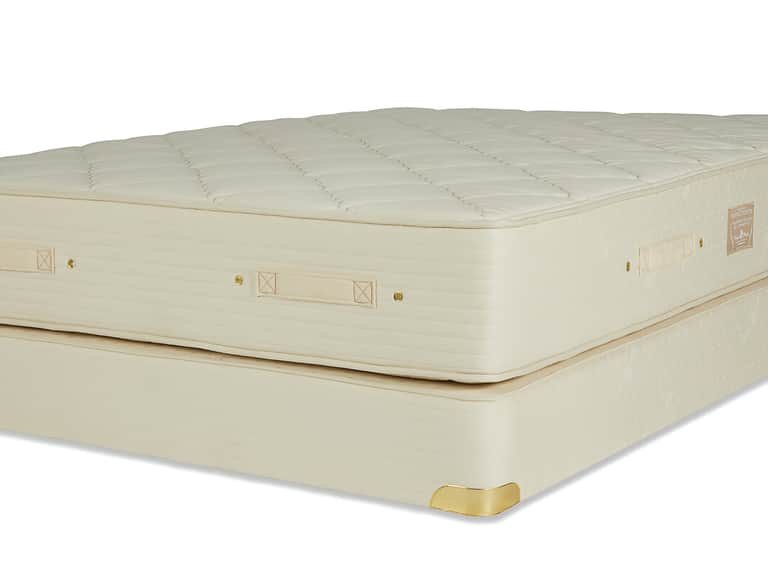
Some mattresses are explicitly described as compatible with adjustable bases. For example, the listed details for the Royal-Pedic Natural Latex Quilt-top Mattress state that it may be used on an adjustable bed base. That is a useful starting point, not a substitute for checking the current instructions for both the mattress and the base. Compatibility can depend on the complete setup, including size and support requirements.
Also consider any topper, protector, or other bedding layer. A thin, flexible layer may move with the mattress, while a bulky or tightly fitted cover may shift, bunch, or pull when the bed changes shape. Check that fitted sheets have enough depth and that bedding stays in place through the range of motion you plan to use.
The practical test: movement, controls, and noise
A comfortable position is only part of everyday usability. You’ll also want to know whether the base is straightforward to operate, moves smoothly, and works well with your room. If possible, try the controls before settling on a model. Can you tell which button raises the head or foot? Are the controls easy to reach in the dark? Does the base respond at a pace that feels manageable?
- Ease of adjustment: Try moving the head and foot sections separately, then together. Notice whether the controls feel intuitive.
- Returning to flat: Make sure you know how to lower the base quickly and reliably.
- Sound: Listen to the motor in the room where you’ll use it. A sound that seems minor in a showroom may be more noticeable at night.
- Power and access: Check outlet location, cord routing, and whether the plug can be reached without moving heavy furniture.
- Room clearance: Allow for the base’s movement and confirm that nearby tables, walls, and cables won’t interfere.
- Movement while changing position: See whether you can turn, sit up, and get out of bed comfortably at your preferred incline.
Features such as massage functions, lighting, or preset buttons may sound appealing, but it helps to separate extras from essentials. The basics are dependable movement, controls you can use comfortably, a suitable mattress, and a position that works for your body. Consider which functions you’ll realistically use rather than choosing solely by the length of the feature list.
Sharing an adjustable bed
For two people sharing a bed, positioning becomes a conversation as well as a comfort question. One person may want the head raised while the other prefers a flat surface. Some systems allow separate adjustment on each side, while others move both sides together. Confirm exactly how the chosen configuration works before assuming each sleeper can set an independent position.
Try the arrangement together if you can. Pay attention to movement transfer, the space available at each side, and whether one person’s preferred angle changes the other person’s ability to relax. Different sleep schedules also matter: if one sleeper likes to sit up and read while the other is already asleep, consider how adjustments, light, and motor noise might affect the person lying down.
Discuss everyday habits rather than only ideal positions. Who controls the remote? Is it easy to find and operate without turning on a bright light? Will each person be able to get in and out of bed without disturbing the other? These small questions can reveal whether a setup works outside a quick trial.
For households with children, pets, or frequent visitors, remember that a moving base has parts that change position. Follow the manufacturer’s safety guidance, keep cords managed, and use the bed only as intended. Make sure users understand how to operate the controls and know when the base is moving.
Build a simple at-home trial
If you’re considering an adjustable base, test it gradually rather than making a single decision based on the highest angle. Begin with the mattress and bedding you plan to use. Lie in your usual sleep position, adjust the head by a small amount, and pause to notice whether your neck and back feel relaxed. Then test the foot section separately, followed by a combined position if that feels comfortable.
Repeat the trial in positions you actually use: reading, resting, and getting into or out of bed. If you share the bed, include your partner in the process. Try a short period of rest at a promising setting, and then return the base to flat to compare. A brief test cannot tell you everything about overnight comfort, but it can help identify obvious fit or usability problems.
Keep notes if several settings seem promising. Record the approximate angle or preset, the activity, and what you noticed afterward. That makes it easier to distinguish a position that simply feels novel from one that consistently suits you. Change one factor at a time when possible—otherwise, a new pillow, mattress topper, and bed angle may all be competing for credit or blame.
Give yourself permission to choose a modest adjustment. There is no prize for the steepest incline or the most complicated preset. If you sleep best with the base flat, that may be the right result for you. The useful question is not “Which position is best for everyone?” but “Which setup feels comfortable and practical for my life?”
Care, setup, and long-term use
Follow the installation instructions carefully, including guidance on the bed frame, legs, weight limits, and mattress retention. A base needs stable support, and improvised placement can affect movement or safety. Keep the area beneath the bed clear enough for moving components, and inspect cords from time to time to ensure they are not caught, stretched, or pinched.
Mattress care still applies when the bed is adjustable. Use the mattress according to its own instructions, and don’t fold or sharply bend it unless the manufacturer specifically permits that movement. If the mattress shifts during adjustment, check that it is positioned and secured as directed. Repeated movement can make loose bedding or an incompatible layer more apparent.
For cleaning or troubleshooting, consult the manuals for both pieces of equipment. Avoid guessing about electrical parts or dismantling the base. If movement becomes uneven, a noise changes noticeably, or a control stops responding, stop using the affected function and contact the appropriate manufacturer or service provider for guidance.
Warranty terms are worth reading before installation. Some policies specify compatible bases, required support, or care procedures. Keep purchase and setup information together so you can refer to it later. A few minutes spent understanding the rules can prevent confusion if the bed needs attention down the road.
Common assumptions to leave behind
“A higher angle must be more comfortable.” Not necessarily. A small change may feel better than a pronounced incline, and some sleepers prefer a flat surface.
“Any mattress can go on any adjustable base.” Compatibility is specific to the mattress and base. Check both manufacturers’ guidance rather than relying on appearance or a general claim about mattress material.
“A preset is the right position for sleep.” Presets are convenient starting points, not personalized instructions. Adjust them to suit your body and routine.
“Adjustability is only useful at bedtime.” Some people value it for reading, resting, or getting in and out of bed. Whether those uses matter depends on your daily habits.
“If it feels good for a minute, it will feel good all night.” Short trials are helpful, but sustained comfort and ease of movement matter too. Pay attention over time and make changes gradually.
A quick checklist before deciding
- Does the mattress manufacturer confirm compatibility with an adjustable base?
- Does the base support your mattress size and meet its weight and setup requirements?
- Can you find a head or leg position that feels comfortable in your usual sleep posture?
- Can you change position, turn over, and get in and out of bed without undue effort?
- Are the controls, sound level, power access, and room clearance acceptable?
- If you share the bed, can both sleepers use the configuration comfortably?
- Have you checked installation, care, safety, and warranty instructions?
The bottom line
An adjustable bed can offer a more flexible way to arrange your sleep surface, but the best position is personal and often surprisingly subtle. Start with your normal sleep posture, make small changes, and pay attention to alignment, pressure, movement, and how easy the bed is to use in everyday life. Just as important, verify that the mattress and base are designed to work together.
For shared beds, test the arrangement as a team. For any sleeper, consider the whole routine—from climbing into bed to lowering it again in the morning. When the setup feels comfortable, dependable, and easy to live with, the adjustments have done their job. And if the flat position remains your favorite, there is no reason to change it merely because the bed can.
Frequently asked questions
Can an adjustable bed help every sleep position?
It may suit sleepers with different habits, but no position or feature is right for everyone. Side, back, stomach, and combination sleepers can experience an incline differently. Testing modest adjustments is more useful than assuming one setting works for all.
Can I use my current mattress on an adjustable base?
Only if the mattress is compatible with the base and its manufacturer’s instructions allow it. Check both sets of guidance, including size and support requirements, before installation.
Should I raise my head or my legs?
That depends on your comfort, posture, and intended use. Try each adjustment separately at a gentle angle and notice how your body responds. Consult a healthcare professional for advice related to a medical condition.
Is it okay to sleep with an adjustable base flat?
Yes. An adjustable base can remain flat whenever that is the most comfortable option. Its available movement gives you choices; it does not require you to sleep at an incline.